Fait Accompli?

     David Angel

Don’t bite into the berry, hon
I want to snap a picture of it
Write about it just for fun

Light verse, it’s not English lit —
'tis a blackberry for goodness sake!
Not the sinking of the Titanic

It’s real, not an AI fake
Twin berries into one heart fused
Made me think about my fate

A life of notions disabused
Hardened by repeated knocks
Must change or watch my life blood ooze

Sense the ticking of the clock
Picking up the pace
Time itself ordained to mock

This man, who tired of the race
Knew he must return to heart
His highest card  — far from an ace

The berry, nature’s taste of art
The blood of life still in his veins
Animating hand and heart

Thought about his woes and banes
Shrugs and callousness and dirt
Fettered by his self-made chains

Forged in blood and sundry hurts
Mistakes repeated, slow to learn
Temptation magnet, drawn to flirt

An ancient wound — not a burn
Jagged glass, forboding scar
Between the cradle and the urn

Red dwarf of a fallen star
The gash subsumed his line of fate
God knows what we really are

Head line pierced, was it too late?
Heart line fierce, yet penetrated
Returned the berry to her plate

Destiny is karma, fated
Scarred reminder of the glass
How long my palm bled unabated

If only we could change the past

Copyright ©️ 2026, David Angel, All Rights Reserved

PoetNote -

No it's not AI just because I used three em-dashes. I reckon I just like dem em-dashes!

“Terza Rima

	•	Chain rhyme tercets
	•	ABA BCB CDC DED…
	•	Usually ends with a single line or coup
	•	Often in iambic pentameter in English

The terza rima is a poem, Italian in origin, composed of tercets woven into a complex rhyme scheme.

Rules of the Terza Rima Form
The end-word of the second line in one tercet supplies the rhyme for the first and third lines in the following tercet. Thus, the rhyme scheme (aba, bcb, cdc, ded) continues through to the final stanza or line." *

* Poet Note - a terza rima usually concludes with either a single line that rhymes with the middle line of the previous tercet or a final couplet.

"Terza rima is typically written in an iambic line and, in English, most often in iambic pentameter.

There are no limits to the number of lines a poem composed in terza rima may have.

Terza rima was invented by the Italian poet Dante Alighieri in the late thirteenth century to structure his three-part epic poem, The Divine Comedy. Dante chose to end each canto of the The Divine Comedy with a single line that completes the rhyme scheme with the end-word of the second line of the preceding tercet."

- poets. org

"The basic structural component of The Divine Comedy is the canto. The poem consists of 100 cantos, which are grouped together into the three sections, or canticles: Inferno, Purgatorio, and Paradiso. Technically, there are 33 cantos in each canticle, plus one additional canto, contained in the Inferno, which serves as an introduction to the entire poem. Indeed, the divine number of three is present in every part of The Divine Comedy. The poem’s rhyme scheme is the terza rima, an Italian verse form consisting of stanzas of three lines. For example, the first tercet of the first canto reads:

Nel mezzo del cammin di nostra vita
mi ritrovai per una selva oscura,
ché la diritta via era smarrita.

When I had journeyed half of our life’s way,
I found myself within a shadowed forest,
for I had lost the path that does not stray.

Translation by Allen Mandelbaum, Inferno, 1980

In the complex metrical scheme of the terza rima, the first and the third line of the first tercet rhyme with one another. Additionally, the second line rhymes with the first and third lines of the stanza that follows. Finally, the entire canto ends with a line that rhymes with the second line of the last full stanza. Dante was the first poet to use the terza rima for a long poem."

- brittanica. com

"Possibly developed from the tercets found in the verses of Provençal troubadours, who were greatly admired by Dante, the tripartite stanza likely symbolizes the Holy Trinity. Early enthusiasts of terza rima, including Italian Renaissance poets Boccaccio
and Petrarch were particularly interested in the unifying effects of the form....

Lord Byron and Percy Bysshe Shelley also experimented with the form.

Those who have written in terza rima usually employ near and slant rhymes, as the English language, though syntactically quite versatile, is rhyme poor. Acquainted with the Night by Robert Frost is an example."

- poets. org

fait accompli
/fĕt″ ä-kŏm-plē′, fāt″/

noun
An accomplished, presumably irreversible deed or fact.
An accomplished fact, something that has already occurred; a done deal.
An irreversible accomplishment.

An angel who misplaced his wings.

- merriam-webster. com

Palmtography by David Angel


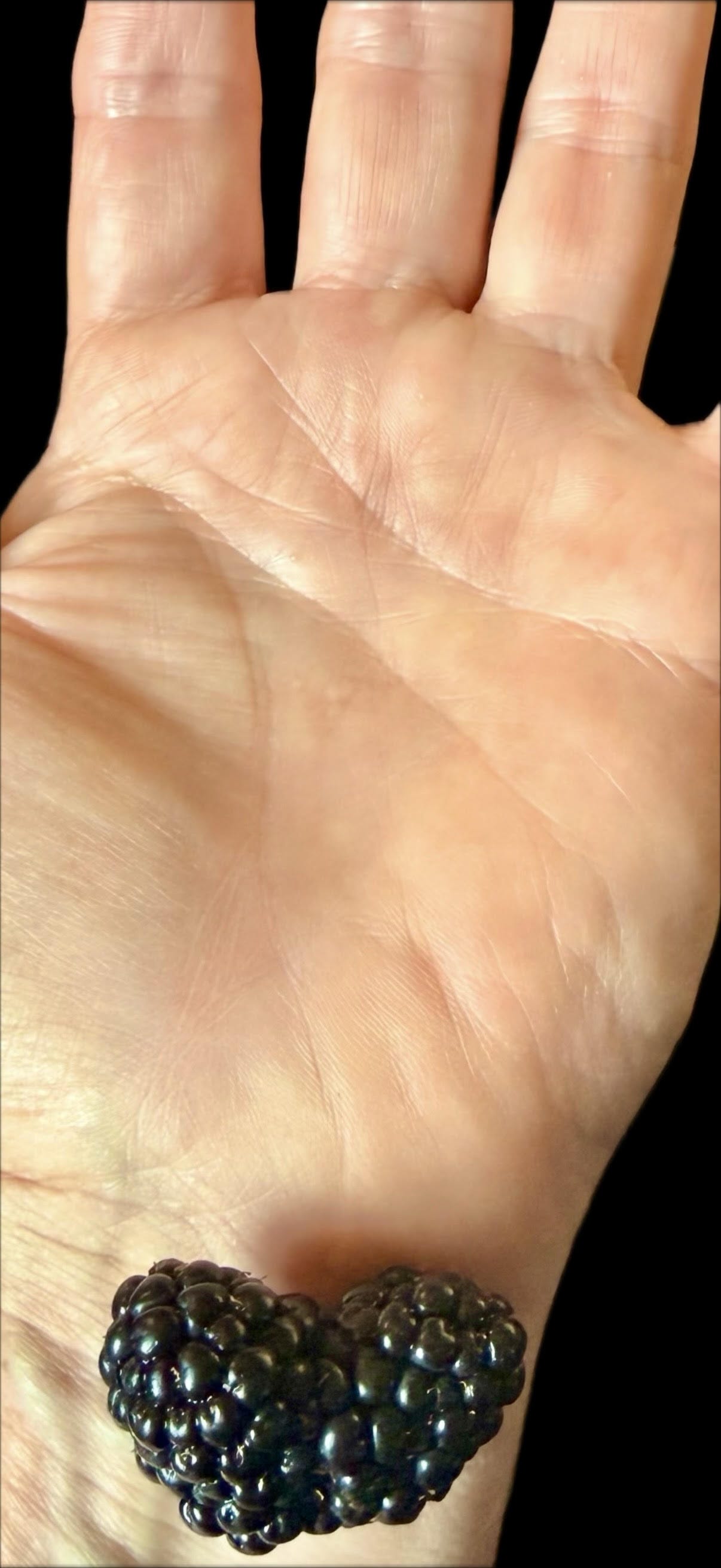
Weird berry, that one! A twin. Looks tasty. Scar, not so good. Thanks for the instruction!