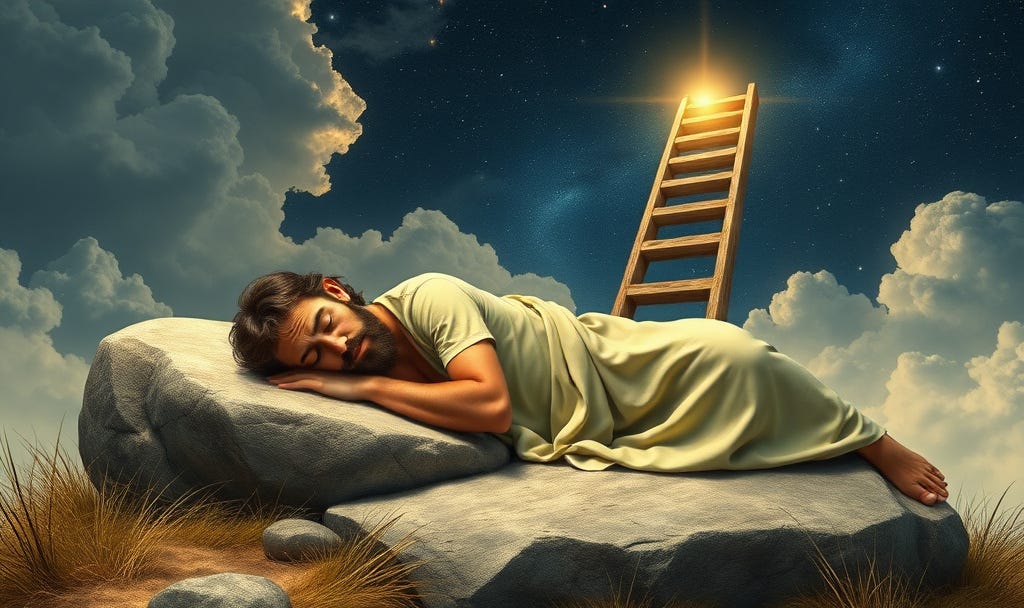
Jacob’s

     David Angel

Ladder to the Infinite
In Judaism, prayer
Christians know the ladder was
nailed in the morning air

The human being tries to ascend
the rungs between our fallen world
and God, whose Brush created art
Knows which of our faulty hearts

Deserve some Grace, deserve some Hell
Firebrands He knows too well
Deserve the land of Nod
Until they take heed of His rod

I read but can’t make heads or tails
Of the tale how Jacob slept
Head upon a rock, he sighed
With stiff neck, Jacob wondered why

Copyright ©️ 2025 David Angel, All Rights Reserved


PoetNote -

"Jacob’s Ladder

Angels Ascending and Descending

"In the Book of Genesis, Jacob’s vision at Bethel— his 'Ladder' stands as one of the Old Testament’s most theologically rich passages, revealing truths about angels’ mediatorial function, divine providence, and (for Christians) Christ Himself as the true mediator between heaven and earth.

This encounter occurred at a pivotal moment in Jacob’s life, as he fled from Esau's murderous wrath, alone and fearful, sleeping on a stone pillow in the wilderness. What began as a night of desperation became an occasion for divine revelation.

The narrative describes Jacob’s dream: 'And he dreamed, and behold a ladder set up on the earth, and the top of it reached to heaven: and behold the angels of God ascending and descending on it.'

The Hebrew word translated ‘ladder’ (סֻלָּם, sullam) appears only here in Scripture, generating discussion about its precise meaning. Some suggest a staircase or ramp, others a ladder proper. Ancient ziggurats—stepped temple-towers—may provide cultural background, as Mesopotamian peoples built these structures believing they connected heaven and earth.

Jacob’s vision subverts this pagan notion: God doesn’t require human-built structures to access earth; He establishes His own means of heaven-earth communion. (Prayer, in Judaism)

Crucially, the vision doesn’t merely show angels moving between realms; it reveals Yahweh Himself standing above the ladder: ‘And, behold, the LORD stood above it, and said, I am the LORD God of Abraham thy father, and the God of Isaac. (Genesis 28:13) This theophanic (appearance of a diety) element distinguishes the vision from mere angelophany. The angels serve as visible manifestation of invisible providential care, but the LORD Himself communicates covenant promises: the land blessing, the seed promise, the universal blessing through Jacob’s descendant, and the personal assurance ‘I am with thee, and will keep thee in all places whither thou goest.’

Jacob’s response upon waking demonstrates proper recognition of divine presence: ‘And Jacob awaked out of his sleep, and he said, Surely the LORD is in this place; and I knew it not. And he was afraid, and said, How dreadful is this place! this is none other but the house of God, and this is the gate of heaven’ (Genesis 28:16-17). The word ‘dreadful’ here means awe-inspiring, terrible in majesty—not evil but overwhelming. Jacob realized he had slept at heaven’s gate, the very threshold between divine and human realms. His naming of the place ‘Bethel’ (בֵּית־אֵל, Beth-El, ‘house of God’) permanently commemorates this revelation.

The vision’s significance extends beyond Jacob’s immediate circumstance to reveal broader theological truths: First, it demonstrates God’s providential governance—angels constantly move between heaven and earth, executing divine will and bringing heavenly resources to earthly situations. Second, it reveals that seemingly random places become sacred when God manifests His presence—Jacob’s stone pillow became a pillar, the wilderness waste became Bethel. Third, it assures believers that divine help attends them even in desperate, lonely circumstances—when Jacob felt most isolated, heaven’s ladder connected him to God’s abundant resources."

- kjvstudy. org

Angel & Cici in unison -

Am Yisrael Chai!  -  Praise Jesus!  -  God Bless America!

Hat tip -

Jacob Ate Spicy Falafel and Had the Wildest Dream!, by David Angel (posted November 26, 2025)